
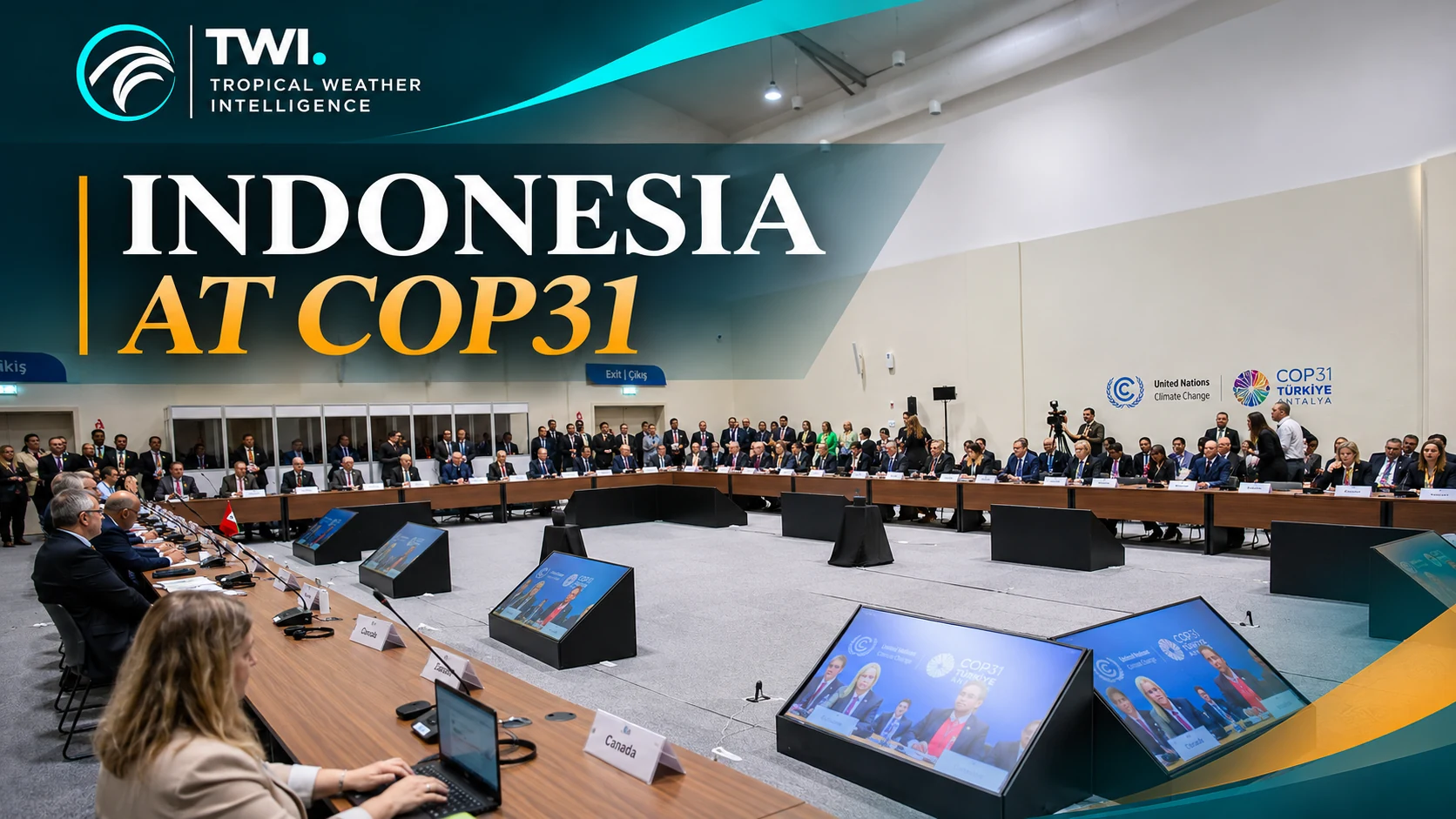
Why Indonesia’s COP31 agenda matters
For an archipelagic country, climate negotiations involve more than emissions targets. Indonesia’s interests also include adaptation, climate finance, energy transition, protection of vulnerable communities and reliable hydrometeorological information. This article evaluates priorities that deserve attention; it does not claim that a specific Indonesian proposal has been formally adopted at COP31.
A tropical country with compound hazards
Extreme rainfall, river flooding, coastal inundation, heat stress, convective wind and lightning create overlapping risks. Monsoon evolution, equatorial waves, the Madden–Julian Oscillation, ENSO and the Indian Ocean Dipole can alter the background conditions for severe weather. Climate change may modify the longer-term distribution of some hazards, while local development patterns determine who and what is exposed.
Early warning is an investment in adaptation
A useful early-warning chain begins with continuous observations, quality-controlled data and skilful forecasts. It must continue through impact assessment, coordinated warnings and last-mile dissemination. Satellite products, radar, upper-air measurements, rain gauges, river sensors and numerical prediction each contribute different pieces of evidence. Their value increases when agencies can operate them consistently and communicate uncertainty clearly.
Energy transition and atmospheric science
Reducing greenhouse-gas emissions is central to long-term climate stabilization. An energy transition also requires attention to electricity reliability, infrastructure siting, renewable-resource variability and physical climate risks. Meteorology can help assess wind and solar resources, extreme-weather loads and the resilience of transmission infrastructure, but it cannot substitute for broader engineering and social-impact assessments.
Regional cooperation can strengthen resilience
Weather systems and moisture transport cross national borders. Shared datasets, compatible warning protocols, training and research partnerships can improve regional situational awareness. For Indonesia, cooperation with Southeast Asian partners should complement strong domestic observing networks and sustained support for national and local institutions.
What counts as a meaningful outcome
Practical indicators include transparent implementation plans, adequate adaptation funding, durable observing infrastructure, improved forecast verification and evidence of warning messages reaching at-risk people. TWI will distinguish formally adopted COP31 decisions from negotiations in progress and will update its interpretation as primary documents become available.