
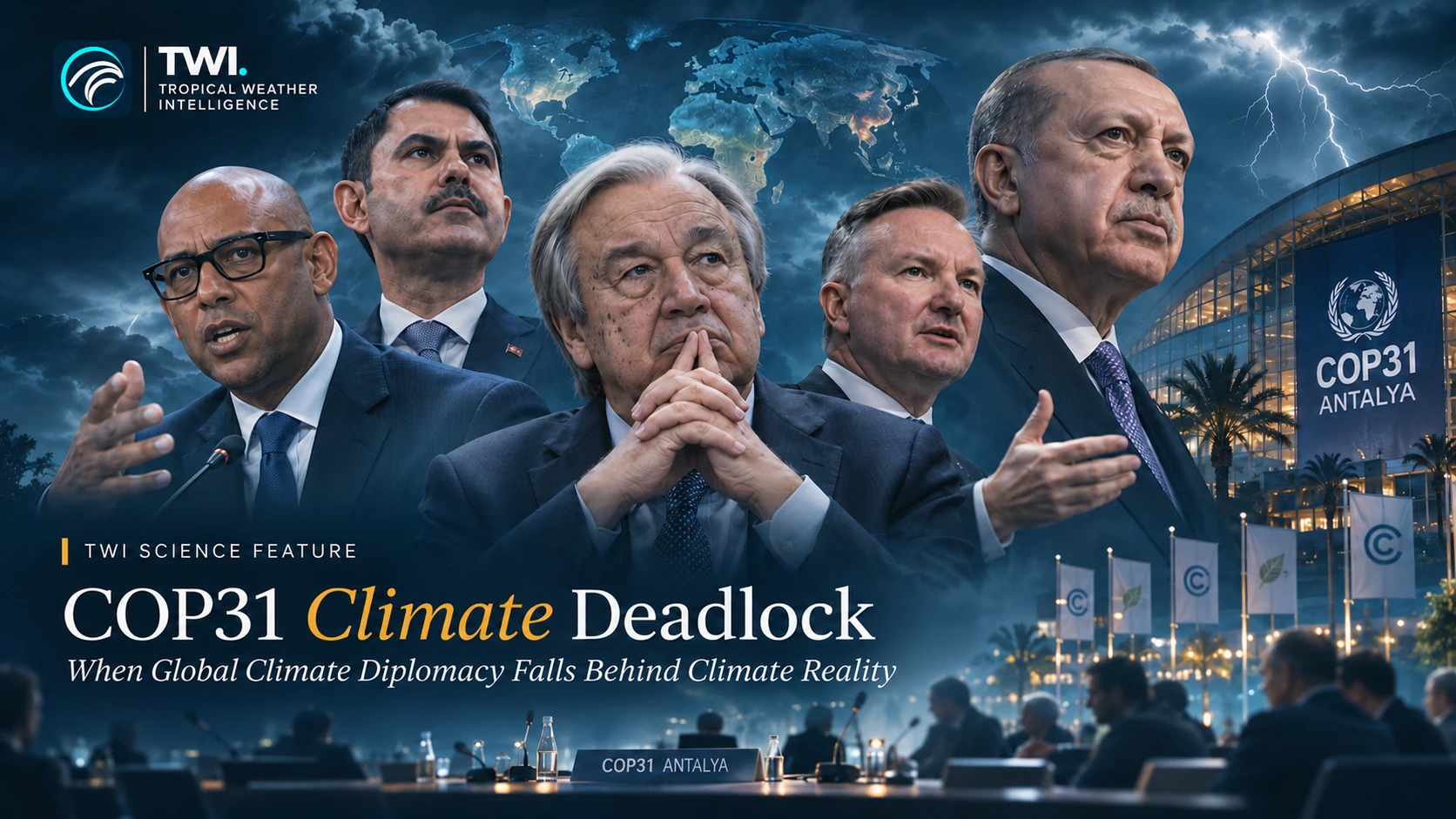
A Summit Without an Overarching Agreement
COP31 concluded in Antalya, Türkiye, on 22 November 2026 after negotiations extended beyond the scheduled closing date. Parties did not reach consensus on the proposed Antalya Pact, the Presidency-led political outcome intended to articulate a shared direction for accelerated climate action.
The result was a significant diplomatic disappointment, but it was not the failure of every agenda item. Several negotiating decisions moved forward, and the Paris Agreement remains in force. For Indonesia, the distinction matters because climate commitments influence the resources and policy environment needed to reduce future risks.
What Reached a Deadlock
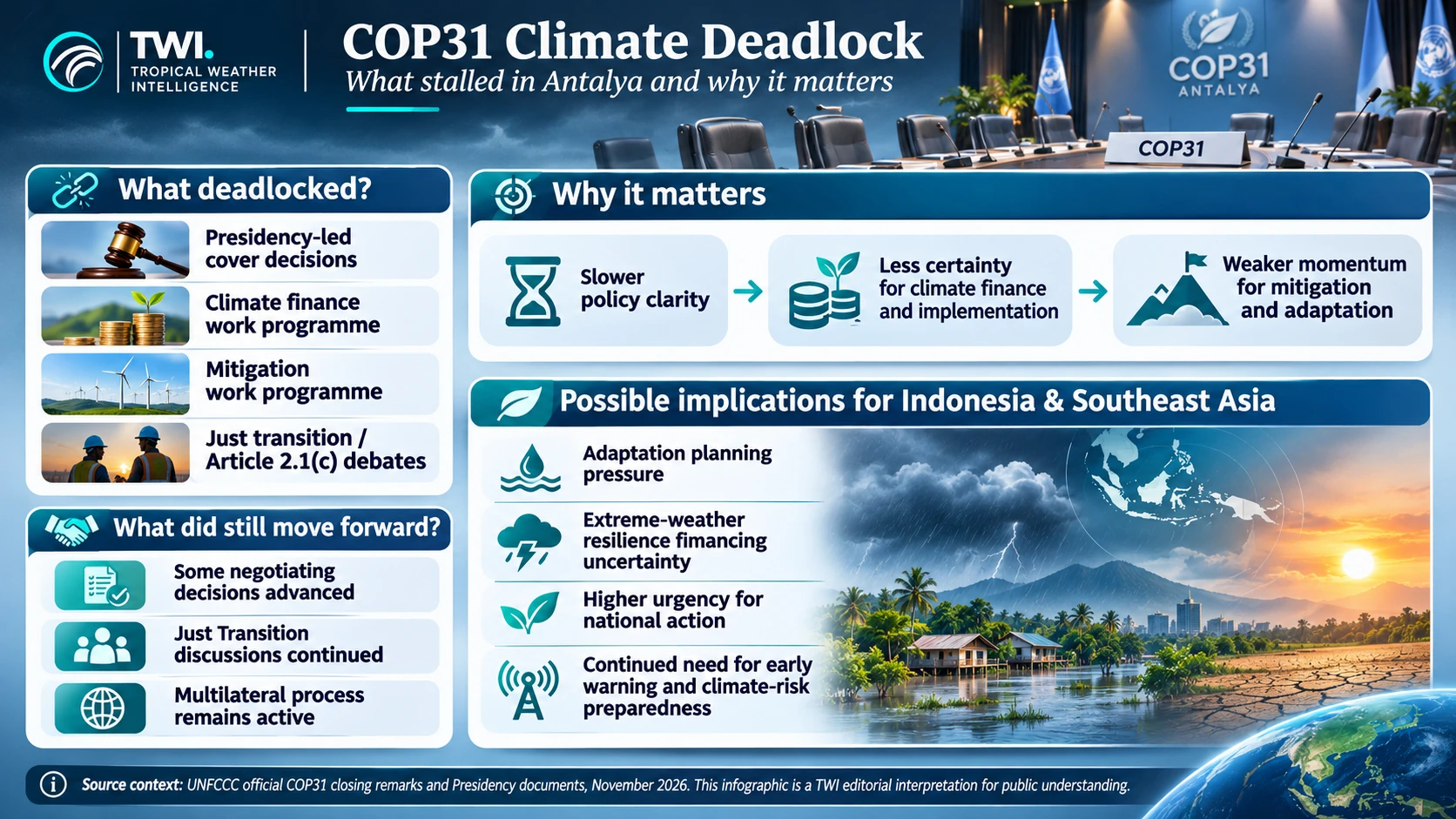
Fossil fuel transition. One central division concerned whether the overarching decision should explicitly strengthen language on transitioning away from fossil fuels. Parties differed over ambition, energy security, national circumstances and how past commitments should be reflected.
Finance and implementation. Developing countries sought clearer and more predictable support for mitigation and adaptation. Outstanding disagreements covered the balance of responsibility, access to finance and practical delivery. These tensions should not be interpreted as proof that every finance-related agenda item failed.
Political consensus. Negotiations under the UN climate process depend on consensus among countries with different energy systems and development priorities. That institutional requirement makes a single political umbrella decision especially difficult when the positions remain far apart.
What Still Moved Forward
COP31 was not devoid of negotiated outcomes. The UNFCCC closing remarks acknowledged decisions including on Just Transition. Other workstreams continued, even while the Presidency-led overarching decisions could not be agreed.
An adopted sectoral decision and a rejected overarching political text must not be described as the same outcome. This distinction helps readers assess COP31 without overstating either its success or its failure.
The Science Continues Regardless of Diplomacy
Greenhouse gases affect Earth’s radiative energy balance, contributing to warming of the atmosphere, land and oceans. A warmer atmosphere can hold more water vapour. Under approximately constant relative humidity, saturation vapour pressure rises by about seven percent per degree Celsius of warming, consistent with the Clausius–Clapeyron relationship.
This thermodynamic increase can intensify heavy precipitation when moisture supply and atmospheric dynamics are favourable. It does not mean every storm becomes stronger or that any individual flood can be attributed to climate change without a dedicated assessment.
Rainfall extremes over the Maritime Continent depend on interactions among large-scale circulation, local convection, moisture transport, topography, land use and exposure. Similarly, tropical cyclone formation involves vertical wind shear, vorticity, ocean heat and several other controls in addition to temperature.
Why This Matters for Indonesia
Adaptation finance: More predictable support can strengthen flood management, coastal protection, water resources and climate-resilient infrastructure.
Atmospheric observations: Weather radars, satellites, surface and upper-air instruments, and hydrological networks are necessary to improve knowledge of hazards and evaluate models.
Impact-based early warnings: Forecasts become more useful when translated into messages that address exposed communities, infrastructure and local vulnerability.
Regional cooperation: Monsoon circulation, ENSO, the Indian Ocean Dipole and the Madden–Julian Oscillation cross national boundaries. Shared data and science across Southeast Asia help improve preparedness.
From Negotiating Text to Measurable Resilience
International agreements matter most when commitments translate into measurable emissions reductions, accessible adaptation resources, operational early warning systems and resilient local institutions.
A political deadlock does not directly cause a particular weather disaster. Its potential long-term consequence is slower collective action at a time when climate-related risks require both emissions reduction and better management of exposure and vulnerability.
The central lesson for TWI is clear: diplomatic decisions may be delayed, but the climate system continues to respond to physical processes.
Konferensi Berakhir Tanpa Kesepakatan Politik Utama
COP31 berakhir di Antalya, Türkiye, pada 22 November 2026 setelah perundingan melewati jadwal penutupan. Negara-negara peserta tidak mencapai konsensus terhadap rancangan Antalya Pact, yaitu keputusan politik yang dipimpin Presidensi untuk menyampaikan arah bersama dalam mempercepat aksi iklim.
Hasil ini merupakan kemunduran diplomatik yang penting, tetapi bukan berarti seluruh agenda perundingan gagal. Sejumlah keputusan tetap dihasilkan dan Perjanjian Paris masih berlaku. Bagi Indonesia, perbedaan tersebut penting karena komitmen iklim berpengaruh terhadap dukungan dan kebijakan untuk mengurangi risiko di masa depan.
Apa yang Mengalami Kebuntuan?
Transisi bahan bakar fosil. Salah satu perbedaan utama berkaitan dengan kebutuhan memperkuat rumusan eksplisit mengenai transisi dari bahan bakar fosil dalam keputusan politik bersama. Negara-negara memiliki pandangan berbeda mengenai ambisi, keamanan energi, kondisi nasional dan cara menegaskan kembali komitmen terdahulu.
Pendanaan dan implementasi. Negara berkembang membutuhkan dukungan mitigasi dan adaptasi yang lebih jelas, mudah diakses dan dapat diprediksi. Perbedaan pandangan mengenai tanggung jawab, akses dan penyaluran dana belum sepenuhnya terselesaikan. Ini tidak berarti seluruh keputusan terkait pendanaan gagal.
Konsensus politik. Proses perundingan iklim PBB mengutamakan konsensus negara-negara dengan sistem energi dan prioritas pembangunan yang berbeda. Mekanisme tersebut menyulitkan pengesahan satu keputusan payung apabila posisi politik masih berjauhan.
Apa yang Tetap Berjalan?
COP31 tetap menghasilkan sejumlah keputusan. Dalam pernyataan penutupan resminya, UNFCCC menyebut keputusan yang telah dicapai, termasuk terkait Just Transition. Berbagai jalur kerja lainnya juga berlanjut, walaupun keputusan politik payung yang dipimpin Presidensi gagal disepakati.
Keputusan sektoral yang telah diadopsi dan rancangan keputusan politik yang tidak disepakati tidak boleh disamakan. Pembedaan ini diperlukan agar hasil COP31 tidak digambarkan terlalu berhasil ataupun seolah seluruhnya gagal.
Proses Iklim Terus Berlangsung tanpa Menunggu Diplomasi
Gas rumah kaca mengubah keseimbangan energi radiasi Bumi sehingga berkontribusi terhadap pemanasan atmosfer, daratan dan lautan. Atmosfer yang lebih hangat dapat mengandung lebih banyak uap air. Pada kelembapan relatif yang kurang lebih tetap, tekanan uap jenuh meningkat sekitar tujuh persen untuk setiap kenaikan suhu satu derajat Celsius, sejalan dengan hubungan Clausius–Clapeyron.
Peningkatan kemampuan atmosfer mengandung uap air dapat mendukung intensifikasi hujan lebat ketika kelembapan dan dinamika atmosfer mendukung. Namun, hubungan ini tidak berarti semua badai pasti menguat atau setiap kejadian banjir dapat langsung diatribusikan kepada perubahan iklim tanpa kajian khusus.
Hujan ekstrem di Benua Maritim dipengaruhi oleh sirkulasi skala besar, konveksi lokal, transport kelembapan, topografi, penggunaan lahan dan keterpaparan. Pembentukan siklon tropis juga melibatkan geser angin vertikal, vortisitas, panas laut dan sejumlah faktor lain di samping suhu.
Mengapa Penting bagi Indonesia?
Pendanaan adaptasi: Dukungan yang dapat diprediksi diperlukan untuk perlindungan banjir, ketahanan pesisir, pengelolaan air dan infrastruktur tahan iklim.
Observasi atmosfer: Radar cuaca, satelit, pengamatan permukaan dan udara atas, serta jaringan hidrologi diperlukan untuk memahami bahaya dan mengevaluasi model.
Peringatan dini berbasis dampak: Prakiraan perlu diterjemahkan menjadi informasi yang mempertimbangkan masyarakat, infrastruktur dan kerentanan lokal.
Kerja sama regional: Monsun, ENSO, Indian Ocean Dipole dan Madden–Julian Oscillation melintasi batas negara. Pertukaran data dan penelitian di Asia Tenggara dapat memperkuat kesiapsiagaan.
Dari Kesepakatan Menuju Ketahanan yang Terukur
Kesepakatan internasional memiliki arti ketika komitmen menghasilkan penurunan emisi yang terukur, akses pendanaan adaptasi, sistem peringatan dini yang berfungsi dan institusi lokal yang tangguh.
Kebuntuan politik tidak secara langsung menimbulkan bencana cuaca tertentu. Risiko jangka panjangnya adalah perlambatan aksi bersama ketika pengurangan emisi dan pengelolaan keterpaparan serta kerentanan perlu berjalan beriringan.
Pesan utama TWI: keputusan diplomatik dapat tertunda, tetapi sistem iklim terus bekerja mengikuti proses-proses fisik.